Mission Science News and Events Education and Outreach Multimedia Gallery For Astronomers
spacer
What's New divider Featured Image Featured Image RSS

May 30, 2013 – WISE Finds Lost Asteroid Family Members
Data from WISE have led to a new and improved family tree for asteroids in the main belt between Mars and Jupiter. Astronomers used millions of infrared snapshots from the asteroid-hunting portion of the WISE all-sky survey, called NEOWISE, to identify 28 new asteroid families. Visit

May 22, 2013 – 2013 NEOWISE Post-Cryo Data Release
NEOWISE and the Infrared Processing and Analysis Center (IPAC) announce the 2013 NEOWISE Post-Cryo Data Release, consisting of over 900,000 3.4 and 4.6 micron images and a database of over 7.3 billion source detections extracted from those images, acquired by WISE between Sept. 29, 2010 and Feb. 1, 2011 after the satellite's sold hydrogen cryogen was completely exhausted. Visit

Apr 23, 2013 – Galaxy Goes Green in Burning Stellar Fuel
Astronomers have spotted the "greenest" of galaxies, one that converts fuel into stars with almost 100-percent efficiency. The findings come from NASA's WISE, NASA's Hubble Space Telescope and the IRAM Plateau de Bure interferometer in the French Alps. "This galaxy is remarkably efficient," said Jim Geach of McGill University in Canada, lead author of a new study appearing in the Astrophysical Journal Letters. "It's converting its gas supply into new stars at the maximum rate thought possible." Visit

Mar 11, 2013 – Closest Star System Found in a Century
NASA's Wide-field Infrared Survey Explorer (WISE) has discovered a pair of stars that has taken over the title for the third-closest star system to the sun. The duo is the closest star system discovered since 1916. Visit


Sky Coverage – this map shows the density of coverage by WISE Read more.arrow
 
WISE statement
black starfield with mostly blue and a few reddish stars

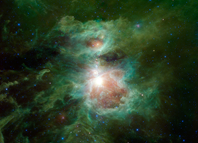
February 5, 2013 – The Cosmic Hearth

The Great Nebula in Orion is featured in this sweeping image from NASA’s Wide-field Infrared Survey Explorer. The constellation of Orion is prominent in the evening sky throughout the world from about December through April of each year. The Orion Nebula (also catalogued as Messier 42) is located in the sword of Orion, hanging from his famous belt of three stars.

More arrow

Featured Lessons

Active Astronomy: Classroom Activities for Learning About Infrared Light
A set of hands-on and demonstration activities from NASA’s SOFIA mission designed to complement instruction on the electromagnetic spectrum for middle and high school students. Visit arrow

Size & Scale of the Universe 
The Universe is very, very big. One cannot reasonably create a scale model of the Universe that includes all of its components—from people to superclusters—and simultaneously scales their distances and sizes. This activity attempts to overcome that difficulty by examining the Universe at different realms.

arrow Size and Scale of the Universe Activity (Teacher Guide) (pdf)
arrow Size and Scale Presentation (pptx)
arrow Size and Scale of the Universe Activity (Student Worksheet) (pdf)
arrow Room Size Conversion Calculator (xlsx)
arrow Size and Scale Glossary (pdf)


twitterfacebook
UCLA LogoJPL logo
Display issues? | Last updated 5/30/13 © UC Regents
site design by Ideum
site maintained by CSE@SSL CSE@SSL
JPL UCLA JPL UCLA Ideum: Ideas + Media